“Fits every mattress. One piece in every pack.”
Variant scope is missingPRODUCT FACTS & ENRICHMENT
The truth of your products. The context AI needs.
Connect every source. Translate every asset. Build product knowledge that is consistent, traceable and ready for AI.
Mattress depth: 20–30 cm. Match the guide to the selected variant.

3 variants C1 records and source excerpts are illustrative. Photo: Secret Linen Store; it does not verify the example specifications.

One product. A complete knowledge system.
The four-stage architecture connects source material, product facts, information formats and AI entry points. Evidence and outcomes return to the next version.
How a product becomes understandable and recommendable to AI
Combine shopper questions, product data and commercial constraints into verifiable product facts, then compile them for different AI entry points.
Product data sources
Shopify · WooCommerce · Product pages
Reviews · Q&A · Reddit · Support · Social
PIM · ERP · OMS · PLM · Brand policies
Unified product facts
One product, a set of verifiable facts
Interpret images, video, audio and documents alongside source product facts to create reviewable information. Prices, inventory and policies remain hard constraints.
Information formats
Product facts · Contextual Q&A · Illustrated explanations · Video summaries · Evidence
Attributes · Features · FAQs · JSON-LD · metafield
Feed distribution · MCP tools · Skill packages

AI entry points
THE DIFFERENCE, MADE VISIBLE
Better context. Without changing the facts.
One fitted sheet. Three SKUs. See how fit, packs, care and unsupported claims become clearer, then see what AI enrichment adds.
Match each fact to its SKU, source and version.
Fix missing compatibility fields and pack scope. Escalate conflicting care instructions, and keep unsupported claims out of approved copy.
Shared product page · S1
“Fits every standard mattress. One sheet per pack. Machine wash and tumble dry. Hypoallergenic and antibacterial.”
Mattress width, length and depth are missing from readable fields.SKU records · S2 / S5
C1-150-1: 150 × 200 cm / 1 sheet. C1-180-1: 180 × 200 cm / 1 sheet. C1-180-2: 180 × 200 cm / 2 sheets.
A product-level “1 sheet” statement is wrong for the two-pack.Care guide · S4 · 2026 edition
Hand wash at ≤30°C. Do not tumble dry. Confirm which current batches and SKUs this version covers.
A newer document alone cannot settle the conflict.| SKU | Mattress fit | Pack contents |
|---|---|---|
| C1-150-1 | 150 × 200 cm | 1 sheet |
| C1-180-1 | 180 × 200 cm | 1 sheet |
| C1-180-2 | 180 × 200 cm | 2 sheets |
- Fit depth
- All three SKUs: 20–30 cm. These are compatible mattress measurements, not finished-sheet dimensions.
- Pack scope
- The selected SKU determines quantity. Pillowcases and props are excluded in packing list S5.
- Care version
- After the merchant confirms S4 applies: hand wash at ≤30°C; do not tumble dry. Keep the conflict open until then.
- Claims
- Hypoallergenic and antibacterial: evidence missing. Cotton composition does not establish either claim.
Confirm both the care version and its scope. The model cannot approve either for the merchant.
Care instructions conflict. Confirm the applicable version and SKU scope before publishing.
Turn specifications into a useful buying decision.
This example uses reviewed fit and packing records S2/S5. Switching SKU changes its dimensions and pack count while retaining shared constraints.
See which facts change, and which constraints stay.
C1 cotton fitted sheet. Ivory. Sizes: 150 × 200 cm and 180 × 200 cm. Mattress depth: 20–30 cm. One- or two-sheet packs.
The shopper still needs answers.
- Which exact SKU matches my mattress and pack choice?
- Does the two-pack include pillowcases?
- What if my mattress is 35 cm deep?
Choose the fit. Know what is in the pack.
Match mattress width, length and depth to the selected SKU. Choose one or two fitted sheets according to the packing list; pillowcases are not included.
- Selected SKU
- C1-180-2
- Mattress fit
- 180 × 200 cm
- Mattress depth
- 20–30 cm
- Pack contents
- 2 sheets
- Material
- 100% cotton
- Not included
- Pillowcases not included
A spare-sheet rotation for a mattress inside the documented fit range.
The documented depth range is 20–30 cm. A 35 cm fit is not confirmed; ask for SKU-specific evidence instead of promising compatibility.
Translate the asset. Keep what each source can actually prove.
Image labels, speech and document rows become different fields. Their source regions, timestamps and review states stay attached.
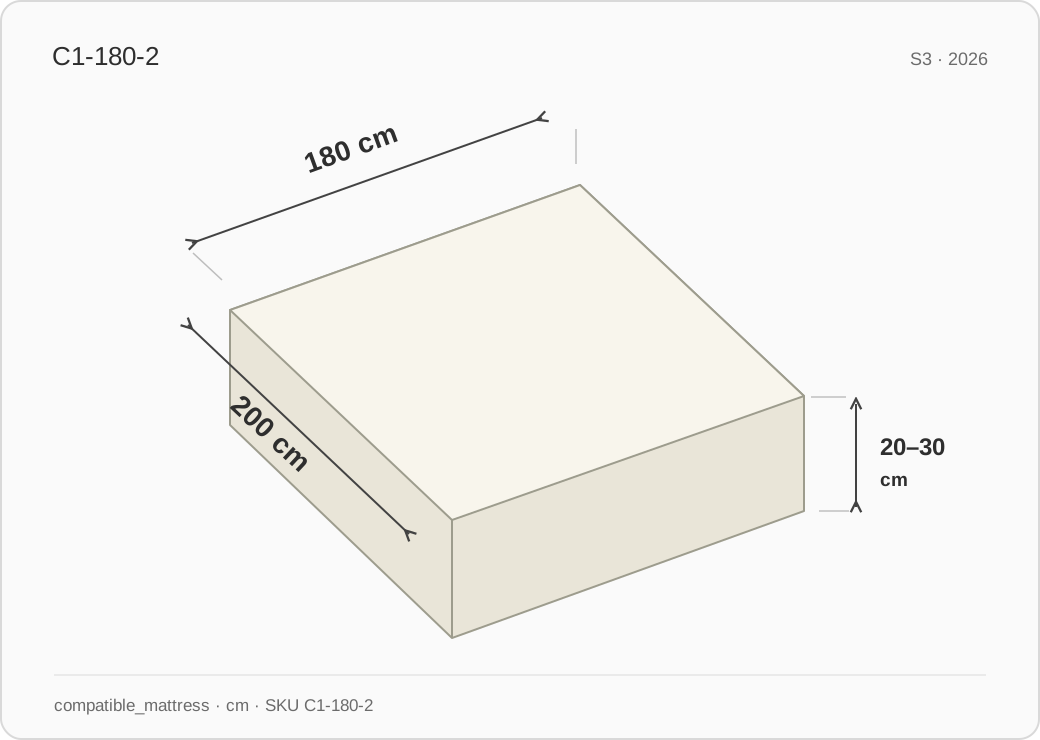
“Measure mattress width, length and depth before choosing a size.”
Composition: 100% cotton. This comes from the record, not the image appearance.
C1-180-2 · 180 × 200 cm · depth 20–30 cm
S3 size guide · dimension labels and SKU regionMeasure the mattress before selecting the SKU.
Illustrative fit-demo.mp4 · 00:18–00:24material: cotton · composition_percent: 100
S2 specification · material row · merchant-reviewedTHE TRUST CONTRACT
More context. Same facts.
Five rules govern the system, from the first source to the final expression.
Keep the original.
Retain source values, product and variant relationships, dates and versions. Normalization never erases the input.
Extraction is not verification.
A packaging claim or review remains a source statement until supported. Extraction confidence and truth are different questions.
Enrich meaning, not missing specifications.
Use cases, intent, FAQs and selling points are reviewable candidates. Materials, dimensions, certifications and compatibility still need evidence.
Read buying conditions from the source.
Price, inventory, delivery, returns and eligibility remain market-specific, time-sensitive facts from authoritative systems.
Resolve conflicts before publishing.
Unknown and conflicting values keep their status. Merchant approval, visibility rules and channel versions control publication.
THE FIELD-LEVEL MODEL
The knowledge behind each product.
Six groups cover what it is, how it is used and how it can be bought. Source facts, AI translations and enrichment remain clearly identified.
Product identity & specifications
Taken from the store and authorized records. Missing and conflicting values keep their status.
- Product & variant IDs, SKU, brand
- Category, attributes, technical specifications
- Materials, dimensions, weight, care
- Evidence-backed compatible accessories
Multimodal details
Extract what the asset contains. Extraction does not verify the claim.
- Image descriptions and text extraction
- Transcripts, key frames, instructions
- Document text, specifications, size tables
- Image regions, time ranges, document pages
Shopping context
Evidence-based semantic suggestions, ready for merchant review.
- Use cases, occasions, audiences
- Buying intent and shopper questions
- Top features and reasons to choose
- Pros, cons and usage limits
Answers & brand expression
Follow approved brand guidance. Store generated copy separately from facts.
- FAQs, comparisons, answer hints
- Brand copy under approved guidance
- Image alt text and visual explanations
- Video summaries and agent prompts
Price & buying conditions
Refresh from authoritative systems under agreed rules. AI does not guess these values.
- Price, currency, market
- Inventory and purchasability
- Delivery, returns, warranty
- Eligibility, validity, last update
Sources & control
Trace information to its source and control what can be published.
- Source, original value, version
- Extraction confidence, verification status
- Missing values, conflicts, review decisions
- Audience, permissions, publication channel
THE ARCHITECTURE IN DETAIL
Four layers. Clear responsibilities.
The overview is the map. These 17 modules define where data enters, how knowledge is built, what gets published and who can use it.
Collect & connect
Connect platform facts, enterprise data and multimodal assets—images, video, audio and documents—through one traceable pipeline.
Commerce platforms & storefronts
Read products, variants, prices, inventory, images and video through official Shopify, WooCommerce and SHOPLINE APIs and webhooks. Supplement them with product-page content and attachments.
Inputs, processing & evidence
- Sources
- API · Webhook · Product page crawling
- Input
- Platform authorization, catalogs, variants, inventory, prices, vendor fields, product pages, and their image, video and attachment links.
- Processing
- Read structured fields and media references with platform connectors. Collect descriptions, FAQs, content blocks and attachments while preserving product and variant associations.
- Output
- Product IDs, variant relationships, titles, descriptions, source images and video, prices, inventory, native metafields, attachment links and page snapshots.
- Evidence boundary
- Preserve the platform, API version, fetch time, page URL and raw response. Read access does not grant permission to write back.
Enterprise & supply chain systems
Connect PIM, ERP, OMS, PLM and supplier portals, plus CSV, XML, PDF, SFTP and APIs, to fill gaps in specifications, fulfillment and manufacturer facts.
Inputs, processing & evidence
- Sources
- PIM · ERP · OMS · PLM · Supplier systems
- Input
- Product master data, bills of materials, specification and sizing tables, packaging images, scans, installation manuals, supplier catalogs and fulfillment rules.
- Processing
- Ingest data through APIs, SFTP or file imports; associate it with SKUs, suppliers and markets. Preserve original documents and versions, and pass scans, charts and manuals to the translation engine.
- Output
- Source documents and their SKU index, plus sourced specifications, dimensions, weights, materials, packaging, manufacturers, supply relationships and lead times.
- Evidence boundary
- Link each field to its source file or API, version and update time. Queue records that cannot be matched to a SKU for resolution.
Customer feedback & questions
Reviews, Q&A, support tickets, return reasons and presales questions reveal how customers describe experiences, concerns and suitable use cases.
Inputs, processing & evidence
- Sources
- Reviews · Q&A · Support · Returns · Reddit
- Input
- Text and image reviews from Shopify, Google, Amazon and Okendo; on-site Q&A, support records, authorized recordings and return reasons; and relevant Reddit, forum, YouTube, TikTok and Instagram content.
- Processing
- Associate content with products and variants and preserve original text, image, video and audio references. Translate media, then group it by topic and sentiment while separating first-hand experiences, hearsay and marketing claims.
- Output
- Shopper questions, image/video/audio experience evidence, common concerns, and candidates for pros and cons, use cases and comparison dimensions.
- Evidence boundary
- Preserve original URLs, author or source type, publication date and cited excerpts. Social discussion is candidate evidence and must not automatically become a verified fact.
Brand assets & policies
Ingest product and packaging images, demo videos, audio and manuals from DAM systems, brand asset libraries, suppliers and policy documents, alongside brand communication rules.
Inputs, processing & evidence
- Sources
- DAM · Brand assets · Supplier materials · Policies
- Input
- Product and detail images, packaging images, demo videos, audio, manuals, brand guidelines, and shipping, returns, warranty and compliance documents.
- Processing
- Register asset IDs, sources, usage scopes, languages and versions; link them to products and variants. Build reusable brand dictionaries and policy rules for translation, enrichment and publishing.
- Output
- Traceable media and document inventories, brand rules, policy facts, permitted promises, prohibited claims and market conditions.
- Evidence boundary
- Version policies by region, channel and effective date. Expired policies must not support public content.
Understand & enrich
Build a unified product fact system with separate source facts, AI multimodal translations and semantic enrichment candidates, each linked to verifiable source evidence.
Unified product facts
Unify products, variants, categories, suppliers, markets and assets in one fact foundation. Associate each image, video segment and document with a specific product.
Inputs, processing & evidence
- Sources
- Platform source facts + External records
- Input
- Platform products and variants, PIM/ERP specifications, policies, review evidence, and source metadata for images, video, audio and documents.
- Processing
- Normalize IDs, SKUs, GTINs, categories, units, markets and languages. Model product–variant–asset relationships and retain sources, versions, timestamps and conflicts.
- Output
- A unified product fact foundation and asset index that distinguish source facts, AI translations and AI enrichment. Authoritative systems continue to govern prices and inventory.
- Evidence boundary
- Trace every field to a source and version. Conflicts require review and must never be silently merged.
Multimodal understanding & translation
Convert product information in images, video, audio and documents into text, structured fields and locatable evidence for the fact enrichment engine.
Inputs, processing & evidence
- Sources
- Images · Video · Audio · Documents → Product facts
- Input
- Product, detail and packaging images; demo and user videos; support audio; manuals, scans and specification tables; and their product and variant associations.
- Processing
- Recognize image content and text, interpret key video frames, transcribe speech, and parse document sections and tables. Align extracted results with SKUs, fields, image regions, audio/video time ranges and document pages.
- Output
- Image descriptions, extracted text, packaging statements, speech transcripts, video summaries and chapters, demo steps, specification fields and citable evidence excerpts.
- Evidence boundary
- Preserve source assets, evidence locations, extraction methods, confidence and review status. Assess extraction accuracy separately from claim validity; packaging statements and user claims are not automatically verified benefits.
Fact enrichment & semantic mapping
Combine source facts, multimodal translations and feedback evidence to propose reviewable attributes, use cases, intent, Q&A and selling points.
Inputs, processing & evidence
- Sources
- Fact foundation + Multimodal translation + Category templates
- Input
- Source product facts; translated images and video; extracted audio and document information; reviews and shopper questions; brand rules, category templates and merchant preferences.
- Processing
- Align entities and meaning across assets, then use rules and models to propose use cases, Q&A, selling points and comparisons. Link evidence and assess confidence without automatically overwriting source values.
- Output
- Attributes, FAQs, use cases, occasions, user intent, pros and cons, key features, compatible accessories, brand guidance, image alt text and agent prompts.
- Evidence boundary
- Attach the generation method, evidence, confidence, review status and version to each candidate. Mark unsupported candidates as inferred or awaiting confirmation.
Live commercial constraints & evidence
Model prices, inventory, shipping, returns, eligibility and variant compatibility as constraints that can expire, be verified and trigger fallback behavior.
Inputs, processing & evidence
- Sources
- Live platform APIs · Policies · Fulfillment systems
- Input
- Prices, inventory, shipping, returns, warranty, purchase eligibility, markets, locales, currencies and variant relationships.
- Processing
- Evaluate sellability by market, currency, time and channel. Detect stale, conflicting or missing data and decide whether publication is allowed.
- Output
- Constraint objects for pages, feeds, MCP and agent queries, with update times, expiry and fallback policies.
- Evidence boundary
- Prioritize live source checks. Models must never guess prices, inventory or delivery promises.
Provenance, versions & quality status
Trace each field to an API, image region, audio/video excerpt or document page, with its update time, reviewer and intended audience.
Inputs, processing & evidence
- Sources
- All ingestion & enrichment nodes
- Input
- Source values, AI translation and enrichment candidates, asset IDs, source links, evidence locations, confidence, conflicts, review comments and channel requirements.
- Processing
- Record provenance, asset versions, image regions, audio/video start and end times, document pages and source excerpts. Manage generation types, approval, visibility, freshness and quality status.
- Output
- Field–asset–evidence links and product fact versions that support review, publishing, rollback and withdrawal.
- Evidence boundary
- Preserve original assets and extraction records. Label source statements, AI observations and verified facts separately; high extraction confidence does not establish claim validity.
Review & express
Compile reviewed product facts into formats that shoppers, crawlers, search engines and agents can consume.
Review & publication control
Review AI candidates by field, product, market and channel. Choose whether to show them to shoppers, agents or both.
Inputs, processing & evidence
- Sources
- Review workspace · Version system
- Input
- Source facts, AI translation and enrichment candidates, original assets, locatable evidence, brand rules, quality alerts and channel requirements.
- Processing
- Review field changes against original image regions, audio/video excerpts and document pages. Support bulk actions, drafts, approval, publishing, withdrawal and rollback; choose shopper, agent or shared visibility.
- Output
- Approved product versions with reviewer, timestamp, visibility scope, version number and change history.
- Evidence boundary
- Generated or revised content candidates require approval under review rules before publication. Dynamic fields such as price and stock refresh under authorization and freshness rules.
Existing product pages & Agentic Page
Improve product detail content on the existing storefront and provide AI-readable expression through Agentic Page.
Inputs, processing & evidence
- Sources
- Existing merchant site · Shopify themes and app blocks
- Input
- Approved titles, descriptions, attributes, FAQs, use cases, selling points, policies and constraints, plus image descriptions, video summaries, instructions and source evidence.
- Processing
- Compose illustrated explanations, contextual Q&A, comparisons, video summaries and chapters, evidence and actions. Keep content readable by shoppers, parsable by machines and linked to its assets.
- Output
- Optimized product pages, Agentic Pages, image alt text, illustrated content blocks, video explanations, citable summaries and their page versions.
- Evidence boundary
- Inspect page source, structured data, versions and publication receipts. A page visit does not establish an AI citation or an order.
Structured data & Shopify writeback
Compile facts into standard structured markup and Shopify-readable fields to reduce parsing effort across entry points.
Inputs, processing & evidence
- Sources
- JSON-LD · Shopify metafields
- Input
- Products, variants, prices, inventory, FAQs, brands and policies, plus approved media links, image alt text, video summaries and evidence references.
- Processing
- Generate applicable Product, FAQ, ImageObject and VideoObject structured markup. Write metafields and product-page content blocks within the platform and theme capabilities.
- Output
- Structured product, Q&A and media data, Shopify metafields, illustrated and video content blocks, and verifiable page source.
- Evidence boundary
- Validate schemas, read platform values back and record page versions. Complete structured data does not guarantee a search rich result.
Feeds, MCP, APIs & Skills
Compile separate outputs for AI platforms and agents using each channel's schema, taxonomy, policies and receipts.
Inputs, processing & evidence
- Sources
- ACP · UCP · Feed · MCP · API · Skill
- Input
- Approved product facts, translated content, original media links, evidence excerpts, channel rules, field mappings, merchant authorization and market settings.
- Processing
- Compile product fields, media links, translated summaries and evidence references against the target channel’s supported schema. Generate feeds, expose MCP/API queries or package Skill knowledge, then validate publishing receipts.
- Output
- Channel-adapted feeds, MCP tools, APIs and Skills with supported media references, product facts, summaries, evidence and synchronization receipts.
- Evidence boundary
- Channels accept different image, video, audio and extension fields. Validate format support, receipt, indexing, citation, tool use and orders separately; a live endpoint does not establish distribution.
Discover & use
AI entry points retrieve and cite product knowledge. Subsequent shopping actions depend on platform permissions and existing commerce interfaces.
AI crawlers & search engines
Crawl public pages and structured markup for indexing, summaries and citation candidates. Feed ingestion and tool calls use separate access paths.
Inputs, processing & evidence
- Sources
- AI crawlers · Search retrieval
- Input
- Public PDPs, Agentic Page and product, FAQ and media markup within those pages.
- Processing
- Crawl, parse, index and retrieve information. Platform rules determine whether summaries or citations are displayed.
- Output
- Discovery, indexing, summaries, citations and product candidates.
- Evidence boundary
- Measure crawling, indexing and citations separately. A request is not shopper traffic, and a citation is not an order.
LLMs & AI search surfaces
ChatGPT, Claude, Perplexity and Google AI Overview use web pages, search results or their supported integrations in response to shopper questions.
Inputs, processing & evidence
- Sources
- ChatGPT · Claude · Perplexity · Google AI Overview
- Input
- Shopper questions, retrieved results, product facts, policy constraints, citations and tool responses.
- Processing
- Understand intent, filter candidates, compare products, explain recommendations and propose next actions.
- Output
- Product recommendations, comparisons, citations and purchase links; cart or checkout entry points depend on platform support and merchant interfaces.
- Evidence boundary
- Reading, citing and recommending depend on platform retrieval, ranking, region, conversation context and user preferences.
Task-based agent
Other task agents may use browsers, feeds, MCP or APIs to search, compare and complete multistep tasks, depending on integration and permissions.
Inputs, processing & evidence
- Sources
- Other task and shopping agents
- Input
- Task objectives, structured product facts, constraints, tool permissions and merchant action APIs.
- Processing
- Plan tasks, call tools, verify prices and inventory, filter products and execute the next action.
- Output
- Completed tasks, product candidates, purchase links, carts or handoff to checkout systems.
- Evidence boundary
- A tool call does not establish user acceptance. Record the agent, task, SKU, tool response and final action.
Personal agents & shopping systems
Personal assistants such as Muse and Dots, alongside shopping systems, combine product facts with lasting preferences, lists and execution workflows.
Inputs, processing & evidence
- Sources
- Muse · Dots · Shopping systems
- Input
- Personal preferences, budgets, historical behavior, product facts, inventory and shipping constraints.
- Processing
- Use long-term user context to filter, remind, compare, repurchase and carry out shopping actions.
- Output
- Personalized recommendations, reminders, purchase decisions, orders and aftersales tasks.
- Evidence boundary
- Authorize and record personal context, platform permissions and order status separately. Inferred preferences must not be treated as merchant facts.
EXPRESSION, NOT DUPLICATION
One knowledge base. Purpose-built expressions.
Approved content is published by version. Price, stock and other changing conditions refresh from authoritative systems under authorized rules.
Agentic Page
Product facts, scenario answers, image explanations, video summaries and traceable sources.
C1-180-2 · 180 × 200 cm · 2 sheets
Does the two-pack include pillowcases?
No. S5 lists two fitted sheets only. Mattress depth: 20–30 cm.
Product detail pages
Approved titles, attributes, FAQs, selling points and media copy, adapted to the storefront.
Check the published page as well as the metafield. A theme block may still display old hard-coded content.
Feeds, MCP & Skills
Package facts, assets and evidence into feeds, tools and reusable agent knowledge.
Product feeds, ACP/UCP adaptations, MCP tools and Skills each follow their own specifications and agreed scope. Checkout remains with the connected commerce platform.
Current starting point: Agentic Page for Shopify. Other connectors, storefront changes and machine integrations are confirmed separately. AI-platform access, indexing and adoption follow each platform’s rules.
A LOOP THAT LEARNS
Publish. Observe. Improve the next version.
Visibility, human traffic and paid orders answer different questions. Keep their evidence separate.
AI visibility
Can AI retrieve and cite it?
Crawler access, parsing, available indexing and citations.
AI traffic
Do shoppers reach your store?
Human referral visits, product views and shopping actions, separated from agent requests.
AI Orders
What does the order evidence show?
Paid orders with available AI-attribution evidence, reconciled with refunds.
A crawl is not a recommendation. A referral is not an order. Attributed orders do not establish causal lift; that requires an experiment.
THE PRACTICAL DETAILS
Built for clarity.
Is this a replacement storefront?
No. The system connects the knowledge behind your existing storefront. Agentic Page is an AI-readable layer on your site; the store and checkout remain in place.
What is the difference between translation and enrichment?
Translation extracts what an asset contains, preserving its image region, time range or page. Enrichment adds reviewable meaning such as use cases, FAQs and selling points. Both keep evidence.
Can enrichment change price, stock or product claims?
Commercial conditions come from authoritative systems. Hard product claims need supporting evidence. Missing and conflicting values remain visible for resolution; approval never rewrites the original source.
Are all sources and output channels already connected?
The page explains the target operating architecture. Agentic Page for Shopify is the current starting point. Additional source connectors, PDP writes, feeds, MCP and Skills are scoped with the team.
Does more context guarantee recommendations or sales?
No guarantee. AI platforms control access, indexing and recommendations. Measure visibility, traffic and order outcomes separately, and use experiments when testing incremental impact.
Your product knowledge.Ready for what comes next.
See how your catalog, assets and buying conditions can work as one system.